

WELCOME TO YOUR FAMILY RESOURCES
Welcome to Read to Them’s Family Resources page! Whether you’ve been reading aloud with your children for years or you are just getting started, this is the place for you. Below, you’ll find:
- Reading Tips – You’d be surprised at all the ways you can get the most out of your read aloud experience!
- Benefits of Reading Aloud – They are wide-reaching, with the potential to greatly impact your child’s life.
- Printables – Download these resources to help make reading aloud a daily habit in your home.
- Videos – Check out why Read to Them authors and literary advocates value reading aloud!
We are so glad to have you join our community of readers. Ready? Set… Go!
READING TIPS
Our reading tips have been carefully compiled to suit readers of all experience levels. Whether you’re about to read aloud for the first time, mid-way through a book, or looking for your next literary adventure, we’ve got you covered! Click on the orange headings to get started and the dark blue headings to learn more.
Readers convey the story or information from the reading material:- adults or older children reading the specific words from the pages of a book or other material
- children or adults telling the story they see in the illustrations of a picture book
- children listening to an older reader (such as one child, a small group of children who are all close in age, or a mixed-age group of children)
- older children or adults listening to a younger reader
- pets (real or stuffies) make great listeners, too!
- board books for the littlest ones
- picture books
- early chapter books
- novels
- nonfiction, memoirs, biographies
- comics and graphic novels
- poetry
- Newspaper articles, magazines, newsletters, and blogs are great to share, too.
Maybe you and your child are both into cooking – subscribe to a cooking magazine to share.
Or maybe baseball is your passion – find a columnist or blogger to follow together.
Follow your child’s interest, but don’t be afraid to branch out and try something unexpected.
- If you always read realistic fiction, try some fantasy or a memoir.
Have a graphic novel fan? Try an illustrated nonfiction book.
Love biographies? Maybe some historical fiction will open a new world.
- Your local public library – Public libraries have everything from board books for babies to self-help books for adults. They are staffed with helpful people – and it is all free!
- Your school library – Another great resource, filled with books for kids and families, and librarians trained in children’s literature.
- Bookstores – Books make a perfect gift, and booksellers can help you find just the right one.
- Thrift stores and garage sales – Books that other families are finished with can help you build your home collection.
- Other families – Trade favorites with friends and have fun chatting about books together.
- Little Free Libraries – Look for one in your community!
Where should we read?
Reading aloud together can happen anywhere so long as you have a reader, a listener, and something to read.
Snuggled up at bedtime is a great place to read, but it isn’t the only place!
- For the little ones, read some silly poems while they splash around in the bathtub.
- Try sharing some animal facts from a nonfiction book over breakfast.
- Waiting for a sibling’s basketball practice or piano lesson to end? The parking lot is the perfect place for another chapter.
- Commuting on the bus or subway? Bring along that new graphic novel everyone is talking about.
- Long car ride? A shared audio book will make the trip go so much faster.
- It builds a feeling of comfort and security, like that book is an old friend.
- Repetition leads to learning, building vocabulary along with an understanding of sentence structure and the rhythm of language.
- With familiarity, the child can gain a deeper relationship with the story, making more meaningful connections to their world.
- These books will be the first books a child will pretend to read and then actually read. They are the stepping-stones to literacy.
- Check your library for books in your native language. Many public libraries and school libraries stock books in the languages spoken in the community.
- Look for bilingual books that present the story in both English and another language in the same book. There are more picture books in this format than novels.
- A caregiver can use picture books to tell stories in their native language using the illustrations as a guide.
- Share folktales from your native culture. Maybe your family could write them down and make your own book out of them or record them as an audiobook.
- Have reading materials in your home – Books, magazines, newspapers, and so on!
- Keep a book going – Find genres that you enjoy and dive into a great book. Let your child see your bookmark making its way through the book, and keep it moving into your next book.
- Bring a book with you – Instead of scrolling through your phone while you wait in the carpool line, pick up your book and get a chapter in.
- Visit the library – Get a big haul from the children’s department and pick up something from the adult section, too. Novels, biographies, cookbooks, self-help books, memoirs – they are all at the library waiting for you.
- Talk about what you are reading – While the latest spy thriller might not be appropriate for a family read aloud, share what you like about it with your child. Make book chats part of your family life.
- Join a book club – Show that reading can be a social experience, too!
Most libraries have:
- Programs for children, teens, and families
- Book clubs for kids and adults
- Computers, printers, and internet access
- Play areas for children
- Study and meeting rooms
- Discount tickets to local attractions
- English as a Second Language classes
- Tools or cookware to borrow
How do I manage digital tech as a tool for reading?
- You can use your phone to access e-books, blogs, and articles to read aloud.
- Your child can read picture books or longer stories on a tablet or computer.
One caution: Many of these programs come with moving images, sound effects, and music. These features are entertaining, but they also inhibit a child’s imagination. - You can find online resources to explore a book like Kahoot! trivia quizzes or publisher-produced content.
- The internet can be a great way to explore topics you first discover in a book or article.
- You can also research authors and find new titles to read. Then go to a library or bookstore and read the book!
- When you’re reading with a child, do your best to remove all digital distractions – phones, tablets, computers, televisions, etc. The mere presence of your phone could distract your child (or you). By putting it away, you are demonstrating that this time is special.
- Protect the time you’ve carved out together by turning off the notifications on your phone. Let others know it’s reading time, and you are not available.
- Honor the story by celebrating memorable moments, characters, illustrations, and language. Enjoy bonding and connecting with your child.
- Have a piece of paper and pencil nearby to jot down anything you want to research after you finish reading.
- Technology is woven into our lives and removing it entirely during reading time might not be possible. Once your family makes reading aloud a special part of your daily routine, however, you will find ways to minimize the distraction.
- Yes! Both comics and graphic novels are fun for kids to read alone, but they can also provide a valuable shared reading experience. They can be a transition from picture to chapter books.
- Comics and graphic novels can be a gateway reading format to encourage developing readers to read more, read wider, and read more confidently.
- Read them together, sitting side by side, so you can explore the illustrations at the same time. Take time to appreciate the details and cool effects in the panels.
Comics:
- The bold art in comics presents a clear narrative line which makes them engaging, easy-to-follow page-turners.
- Comics often contain complex plot lines and rich vocabulary that build reading comprehension skills. Children can acquire more complex verbal language by reading comics than by listening to everyday conversations.
- A broad array of subject matter makes it easy to find something that interests everyone!
- Graphic novels are a growing genre, which includes titles for all age levels.
- You can find compelling original fiction and fascinating nonfiction in this format.
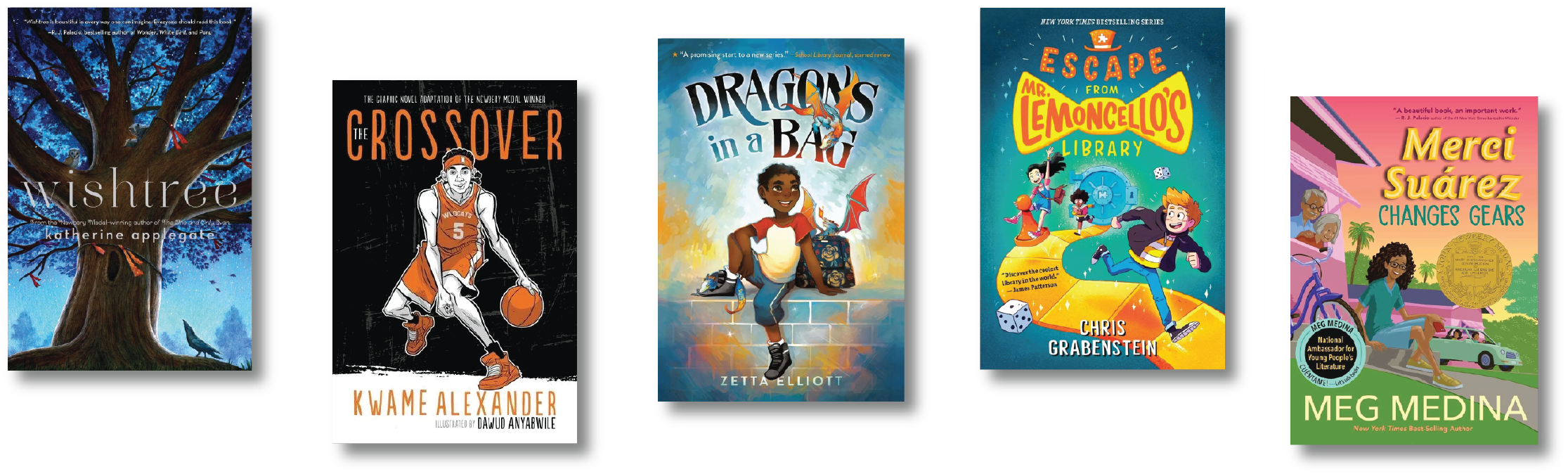
- There are also a growing number of graphic novel adaptations of previously existing novels like Read to Them favorites Escape from Mr. Lemoncello’s Library and The Crossover.
- A graphic novel has its own ‘turn the page’ momentum that can provide an easier entry-way to sustained reading than a standard prose novel.
Public Libraries
Here in Richmond, Virginia, our hometown public library system has a wealth of topic-specific book lists. You can find books about dinosaurs, fairy tales, mindfulness, and more. Not from Richmond? Feel free to use these lists and check out your own local library system – they probably have lists, too!
Read to Them
Read to Them programs feature books specifically chosen for family read alouds. Our curated book list is a great place to start to find books for elementary and middle school listeners.
Reading Rockets
Reading Rockets is a national public media literacy initiative to support families on their literacy journey. They maintain themed booklists for every possible young reader and listener. They also have a book finder to match your family to the perfect book.
Set a realistic goal for how long your reading session will last.
Start with bite-sized reading sessions – a short board book, a picture book, a poem, or one chapter in an illustrated chapter book. Build up your reading and listening stamina and soon your family will look forward to reading more and more. Know when to say when: some days are better for reading aloud than others.
Be expressive!
You don’t have to be an award-winning actor to pull off a successful read aloud, but you should try to put some emotion into the reading. Give it a try – soon you’ll be pulling funny faces and doing voices for the characters!
Vary your rhythm and pace.
Have fun with the language in your book. Slow down and let the suspense build. Pause and let the impact settle. Whisper to highlight the emotion.
Keep reading time engaging and interactive.
You can do this by looking for details in the illustrations. Ask questions about the characters. Point out interesting vocabulary. Try to predict the ending. Read aloud time shouldn’t be a round of 20 questions, but a well-timed open-ended question will help you and your listener engage.
Expect some fidgeting.
While some listeners will sit perfectly still, others may benefit from a quiet activity – a small toy, some crayons, a stuffed animal. Some children like to snuggle up. Others do better sitting apart and engaging with another project. Work together to find the way that works best for your family.
Building your read aloud proficiency is a journey. You will all get better with practice.
It is never too early to share books with a child. Reading with the littlest ones is about experiencing the closeness and joy that books can bring, so don’t worry about reading every word. Instead, focus on sharing this special time with your child. Here are some tips:
- Fold book time into your daily routine – Maybe a book after bath time for some cozy snuggling. Or a book before bedtime to help wind down.
- Have books accessible to you and your child – Be ready to grab a book whenever the mood strikes. Keep books around your home and in your diaper bag, stroller, and car.
- Use an animated voice – Show your enthusiasm for the book. It’s contagious!
- Point out colors, objects, and facial expressions – Books build vital early language skills.
- Serve and volley – Ask questions of your baby even if they are nonverbal. Wait for and respond to their reaction.
- Let babies explore board books – Board books are the perfect bridge between books and toys because they can withstand lots of play. They are perfect to help little ones view books as friends.
- Feel free to narrate a book in your home language – Don’t feel bound by the words in the book. You can make your own story to match the illustrations.
- Explore the illustrations – Identify things by color. Find favorite animals and objects. Count countable things. Look for something new in a favorite book.
- Invite questions – Build on your child’s natural curiosity and use a book as an invitation to learn more.
- Play Finish the Rhyme – When reading rhyming books, stop before the last word and let your child fill it in. Dr. Seuss is great for this game, especially with a book you have read multiple times. “I do not like them in a house. I do not like them with a…?”
- Be alert for literacy opportunities beyond books – Look for letters in the grocery store or on road signs. Make homemade books out of family photos, labeling them with names of people and places. Play rhyming games and sing silly songs. Make up stories together during bath time or meals.
- Match your child’s listening level – Children can listen to far more complex books than they can read independently. Choose books that engage your child on an emotional and intellectual level, not on their reading level.
- Explore the emotions in the story – Books share a broad range of emotions. While reading aloud, mirror the characters’ emotions to make the story more meaningful.
- Make the reading interactive – Pause to invite your child to make a prediction or to discuss something important. Take a minute to explain a tricky word or take a closer look at an illustration.
- Use books to spark conversation – Seek out moments to connect the characters and story to your child’s life. Ask open-ended questions like:
- Have you ever felt like this character?
- What advice would you give the character?
- Who does this character remind you of?
One way to make books come alive is to build relationships with favorite authors. When you find authors you love, read lots of their books. You’ll start to notice things that are familiar – and things that are new – across their books. Here are some ways to appreciate in an author’s body of work:
- Themes – Some authors emphasize themes like friendship, family, or the environment. Can you find themes that run through all of their books? Or does one book head in a different direction?
- Language – Does the rhythm of the text sound the same? Or has your favorite prose author tried a novel in verse? Do the descriptions feel familiar or has the author found a new voice?
- Characters – Do some of the characters feel familiar, like old friends? Or is this book filled with new faces and voices?
- Setting – Some authors have a favorite location to set their books. Others travel around the globe – or even beyond it – with each book.
- Some examples:
- Don’t Let the Pigeon Drive the Bus by Mo Willems – When you see a city bus drive by, look to see if a pigeon is driving!
- Stella Díaz Has Something to Say by Angela Dominguez – Take a trip to a local aquarium or draw some fish to hang on your refrigerator.
- Escape from Mr. Lemoncello’s Library by Chris Grabenstein – Play some board games or make up rebus puzzles.
- Merci Suárez Changes Gears by Meg Medina – Try some Cuban food or go for a bike ride.
- Your connections can go deeper:
- If you have a classmate who has a hard time managing frustration, talk about the challenges Bat faces in A Boy Called Bat by Elana K. Arnold.
- If your family needs to tighten your budget, read Ways to Make Sunshine by Renée Watson and learn how Ryan feels about bargain-brand ice cream.
- If there is a kid in the neighborhood who seems distracted, read Jason Reynolds’s Look Both Ways and talk about how kids can be carrying around some heavy stuff.
Don’t be surprised if after reading the Humphrey books by Betty Birney,
they deliver a strong argument for getting a hamster!
Most importantly – Find your next book!
Here’s some ideas on how:
- Try another book by the same author or illustrator. If you enjoyed Katherine Applegate’s The One and Only Ivan, try Wishtree or Willodeen. Did you have fun with Crown: An Ode to the Fresh Cut by Derrick Barnes? Check out The King of Kindergarten or The Queen of Kindergarten.
- Try a nonfiction book about a topic from a favorite novel. If you loved Grace Lin’s Where the Mountain Meets the Moon or her picture book A Big Mooncake for Little Star, take the opportunity to learn more about China and its culture.
- Try a similar story, but in a different format. If the poems in Kwame Alexander’s The Crossover swept you away, try the graphic novel version. (You can even check out the TV show – but only after you read the book!)
- Read the next book in the series. Did you enjoy your adventure with Zetta Elliott’s Dragons in a Bag? Then you have to read The Dragon Thief to find out about that last dragon! If you went stargazing with Oliver Jeffers and How to Catch a Star, follow it up with The Way Back Home.
- Read a story with similar characters or themes. If you love animal stories like Robert O’Brien’s Mrs. Frisby and the Rats of NIMH then try Nuts to You by Lynne Rae Perkins or Appleblossum the Possum by Holly Goldberg Sloan. Or if a passion for art was sparked by Peter H. Reynolds’ The Dot, you could try Maybe Something Beautiful by F. Isabel Campoy, illustrated by Rafael López.
- Go for something completely different! Try a classic like The Trumpet of the Swan by E.B. White or Holes by Louis Sachar. Or reach for a debut author for something fresh, like Three Strike Summer by Skylar Schremmp. Old favorite picture books like Jan Brett’s The Mitten or something brand new like Berry Song by Michaela Goade.
BENEFITS
When you read aloud with your child, you are equipping them with a wide-reaching array of benefits. Check out the areas of your child’s life that reading aloud can impact and improve:

(Susan Pinker)
Dr. John S. Hutton of the Reading and Literacy Discovery Center at Cincinnati Children’s Hospital is the most recent scientist to explore what happens in children’s brains when they’re reading (or listening to) books and when they’re watching video. He has pioneered the use of MRI technology to learn more. Dr. Hutton explains…
But when you compare that with video, everything kind of drops off.
It’s like the brain stops doing anything… as if nothing is their brain is happening.”
(Dr. John S. Hutton)
So what is happening in children’s brains when they read or listen to books?
Listening to stories activates two main areas of the brain:
- • the parietal-temporal-occipital-associative cortex – an intersection of three lobes
of the cerebrum
• and the cerebellum – an area at the base of the brain

(Dr. John S. Hutton)
- • understanding letters, sounds, and words
• extracting meaning from words
• adding vocabulary
• making mental images from words
• building memory
• interpreting emotion
• developing executive function (flexible thinking, working memory, self- control, planning, organization)
* processing information at higher speeds
(M.C. Gurdon)
In brain development, practice builds connections. The more you practice, the stronger the connections grow to be. So, reading aloud builds the very connections that help your child’s brain grow strong and powerful – and make reading together fun.
emotionally, intellectually, linguistically, developmentally.”
(Molly Ness)
John S. Hutton, Tzipi Horowitz-Kraus, Alan L. Mendelsohn, Tom DeWitt, Scott K. Holland, and the C-Mind Authorship Consortium, “Home Reading Environment and Brain Activation in Pre-School Children Listening to Stories,” Pediatrics 136:3 (September 2015) – https://www.ncbi.nlm.nih.gov/pmc/articles/PMC9923605/pdf/PEDS_20150359.pdf
John S. Hutton, Kieran Phelan, Tzipi Horowitz-Kraus, Jonathan, Dudley, Mekibib Alteye, Thomas DeWitt, Scott K. Holland, “Story Time Turbocharger? Child engagement during shared reading and cerebellar activation and connectivity in pre-school children listening to stories,” PLOS One (May 31, 2017) https://journals.plos.org/plosone/article?id=10.1371/journal.pone.0177398
Ness, Molly, Read Alouds for All Learners: A Comprehensive Plan for Every Subject, Every Day (2023)
(George R. R. Martin)
Modern neuroscience shows a dramatic increase in children’s brain development when they are listening to a story read aloud.
Reading aloud helps students become strong readers and strong students.
They acquire the building blocks of reading: phonemes, vocabulary, grammar, syntax. They acquire the background information essential to grow as readers and students. They increase their attention spans, learning to focus and how to achieve… flow.
Reading stories together helps children become emotionally sensitive and socially aware.
They form an emotional bond with the adult reading with them.
They can learn to recognize, and regulate, their own feelings.
They become aware of the feelings of different characters— and eventually, the people in their own lives.
Responding to and talking about the action in their stories enables them to form and practice communication skills.
Children who listen to a wide array of stories get to experience a wide array of emotions and experiences without ever leaving home. They get to walk in other children’s moccasins.
words, images, and syntactical rhythms they might not get anywhere else.”
(Meghan Cox Gurdon)
(Meghan Cox Gurdon)
Reading aloud helps children acquire “phonemic awareness,” becoming familiar with the sounds that letters and letter combinations make. They learn that letters make sounds and sounds make words, an essential early literacy skill known as phonemic awareness. Children expand their vocabulary. Reading books together doesn’t just provide words; the stories provide the essential context to give words meaning. They learn to recognize, just from exposure and familiarity, what grammatically correct sentences sound like, how grammar works. They also become exposed to a variety of syntax—the different styles authors use to communicate.
You add these things up— phonemes + vocabulary + grammar + syntax —and your child is much better prepared to read, ready to become a successful, even a superior reader.
(Phillip Pullman)
only by augmenting what they already know.”
(E.D. Hirsch)
The building blocks also arm your child with essential tools for communication. Facility with words and information will make them better equipped to formulate an argument, explain an idea, or describe an emotion—from Show and Tell all the way to term papers and presentations.
Being a strong reader and a strong communicator makes all of school easier. Word problems in math are easier to tackle. Scientific concepts are easier to explain. Interactions across historical events are easier to describe. A rich vocabulary and broad background knowledge sets students up for success across disciplines. Reading aloud turns out to be the best thing you can do to help your child become a successful student.
(Albert Einstein)
If you’ve ever read with a child, you know the magic that happens when they become engrossed in a story. It’s like a spell has been cast. They are calm, alert, interested, curious, hungry, eager. They are ready to learn— and they are learning how to focus, developing their attention span.
This is a boon to parents and teachers, but it’s even more important for children and students themselves. It means they can stay engaged longer. With a book. Or a math problem. Or an experiment. Or a project. It means they can persevere. Educators have a special word for this necessary skill. They call it: flow.
It’s that hard-to-reach state of concentration when you’re so absorbed in what you’re doing you lose track of everything else. You can sometimes see it when a kid is absorbed in creative play on the playground or backyard, the dollhouse or treehouse. It’s a critical skill to have as a student – at any age. And it’s become much harder for kids (all of us) to access this state thanks to all the digital distractions demanding our attention.
Reading aloud to your child is the ticket to developing this critical quality: focus, attention span, flow.
(Becoming a Nation of Readers)
Cox Gurdon, Meghan, The Enchanted Hour (2019)
Csikszentmihalyi, Mihaly, Flow: The Psychology of Optimal Experience (1990)
Cunningham, Anne E. et al, “What Reading Does for the Mind,” American Educator (Spring/Summer 1998)
Durkin, Dolores, Children Who Read Early (1966)
Kempe, C. et. al., (2011) “Are There any Matthew Effects in Literacy and Cognitive Development?” Scandinavian Journal of Educational Research. 55 (2): 181–196. [https://www.semanticscholar.org/paper/Are-There-any-Matthew-Effects-in-Literacy-and-Kempe-Eriksson-Gustavsson/111546a1cf6b01a9000eeb42d44d1ad40ceb564c]- cited by Anthony Kelly, corroborating Matthew Effect
Hart, B. et al.,, Meaningful Differences in the Everyday Experience of American Children (1995, 2013)
Logan, Jessica A R et al., “When Children Are Not Read to at Home: The Million Word Gap,” Journal of Developmental and Behavioral Pediatrics 40:5 (June 2019)
McClelland, Megan M. et al., “Relations Between Preschool Attention Span-Persistence and Age 25 Educational Outcomes,“ Early Childhood Research Quarterly 28 (April 2014) [https://doi.org/10.1016/j.ecresq.2012.07.008] – (MCG’s) Oregon St. study
Mullis et al., PIRLS 20001 International Report – IEA Study of Reading Achievement Primary School in 35 Countries
Ness, Molly, Read Alouds for All Learners (2023)
Ogle, Laurence T.; Sen, Anindita; Pahlke, Erin; Jocelyn, Leslie; Kastberg, David; Roey, Stephen; Williams, Trevor, “International Comparisons in Fourth-Grade Reading Literacy: Findings from the Progress in International Reading Literacy Study (PIRLS) of 2001,” National Center for Education Statistics (June 2003)
Recht et al., (1998) “Effect of prior knowledge on good and poor reader’s memory of text,” Journal of Educational Psychology, 80 (1), pp. 16-20. – (cited by Wexler in Molly Ness)
Stanovich, Keith E. et al, “Matthew Effects in Reading: Some Consequences of Individual Differences in the Acquisition of Literacy,” Reading Research Quarterly, Fall 1986, pp. 360-407. (1986) – (cited by Trelease re: Matthew Effect)
Trelease, Jim, The Read Aloud Handbook, 7th ed. (2021)
Wexler, Natlie, forward to Molly Ness, Read Alouds for All Learners (2023), pp. ix-xii
- The famed Hart-Risley study (1995, 2013)
- Follow-ups by Logan et al (2019)
- Discussion by Molly Ness, Read Alouds for All Learners (2023)
- Jim Trelease, The Read Aloud Handbook (1995, 2013)
- Academic studies by Cunningham and Stanovich
- Dolores Durkin’s pathfinding study Children Who Read Early (1966)
- The international PIRLS followups (2001 and 2003)
- Meghan Cox Gurdon, The Enchanted Hour (2019)
- Natalie Wexler’s Forward in Molly Ness’s Read Alouds for All Learners (2023)
- Study cited by Recht and Leslei
- Molly Ness, Read Alouds for All Learners (2023)
- Jim Trelease, The Read Aloud Handbook (2021)
- Research studies by Stanovich
- Research studies by Anderson, Fielding, and Wilson
- Research studies by Kempe and Samuellson
- Meghan Cox Gurdon’s discussion of the Oregon State U. study in The Enchanted Hour (2019)
- Various research evidence cited by Molly Ness in Read Alouds for All Learners (2023)
- Gurdon’s memorable anecdote about reading The Outsiders aloud in The Enchanted Hour (2019)
- Mihaly Csikszentmihalyi’s touchstone work, Flow (1990)
That connection…lets us see each other.”
(Kate DiCamillo)
When reader and listener are sharing a story, both are connecting with the author and the story in the book. They are connecting with each other, sharing the space and time to read together. But acclaimed children’s author Kate DiCamillo highlights another special level of connection. By sharing a story – its characters, plot, and setting – both reader and listener are transported to a “third place.” It is a safe place to lower your defenses and explore emotional highs and lows, and in doing so forge strong connections with each other.
Thus we learn that reading aloud together is a shared experience that yields social, emotional, and empathic benefits.
(Andrea Roure, pre-school teacher)
Children respond emotionally to stories in three ways…
1) They respond to the characters, the scenarios and stories they are in. They can laugh, they can gasp, they can cry. But mostly, they become aware. They experience the world of a wide range of characters.
2) They respond emotionally to whomever they’re reading with. Do you share the same reactions? Do you differ? Do you learn from those differences?
3) Children also self-reflect. They carry those characters and those stories with them. They may be inspired by them, or adapt their behavior as a result of encountering different characters (including animal characters).
Research has established some of the emotional benefits from the mere act of reading stories to children…
Reach Out and Read touts “the positive shared reading behaviors that support parent/caregiver engagement and bonding.” Molly Ness cites evidence explaining that reading aloud together can produce calm (oxytocin) and trust and reduce tress (cortisol), and also help children in learning to regulate their emotions. Dickinson (2011) explains that exposure to concepts and vocabulary provides children with “language that makes it easier for children to regulate their own thoughts and feelings.” Scholastic’s Kids and Family Reading Report, 7th Ed. (2019) reports improved mental health for frequent readers.
strong relationships, sharper focus, and greater emotional resilience.”
(Meghan Cox Gurdon)
(Chris Riddell)
Meghan Cox Gurdon cites and quotes from researchers who explain how literature promotes empathy, social perception, and emotional intelligence. Molly Ness cites further research evidence on the on the development of empathy through reading stories.
(Jacqueline Woodson)
(Meghan Cox Gurdon)
Reading a book together – a picture book or a novel – is a valuable bonding experience. Research has demonstrated children who encounter information “in an adult’s lap” actually understand and remember it better.
Reading aloud together also promotes a principle researchers call “joint attention.” It happens when you’re looking at the same thing together at the same time, experiencing it and interacting with it together, and it yields tremendous benefits.
Reading together presents rich opportunities for interaction and dialogue. For very young children, you invite your child to interact with the text and illustrations. You observe their reactions and then you react, creating the “serve and volley” sequence that builds social skills. With older children, you can discuss themes in the book, decisions made by the characters, and how your child might have done things differently. These conversations give children the chance to role play scenarios outside of their own life experience, and a chance for adults to be part of that exploration.
Molly Ness cites research evidence that describes how reading aloud can promote the discovery and development of interpersonal skills, model how to resolve conflicts and “how to be sensitive to the needs of others,” and help students become better at controlling emotional outbursts.
Billington, Josie et al., “An Investigation into the Therapeutic Benefits of Reading in Relation to Depression and Well-Being,” University of Liverpool (2010): https://www.thereader.org.uk/wp-content/uploads/2022/11/Therapeutic_benefits_of_reading_final_report_March_2011.pdf
Billington, Josie et al., “A Literature-Based Intervention for Older People Living with Dementia,” Centre for Research into Reading, Literature, and Society, University of Liverpool (2017): https://issuu.com/emmawalsh89/docs/a-literature-based-intervention-for
Cox Gurdon, Meghan, The Enchanted Hour: The Miraculous Power of Reading Aloud in the Age of Distraction (2019)
Dickinson, David, “How Reading Books Fosters Language Development Around the World,” Child Development Research, 2012 #3.
Mar, Raymond et. al., “Exploring the Link Between Literature and Empathy: Ruling Out Individual Differences and Examining Outcomes,” Communications 34, #4, pp. 407-428 (2009)
Ness, Molly, Read Alouds for All Learners:A Comprehensive Plan for Every Subject, Every Day (2023)
Reach Out and Read Early Literacy Research Library: https://reachoutandread.org/elrl-main-page/
Scholastic Kids and Family Reading Report, 8th edition (2022): https://www.scholastic.com/content/corp-home/kids-and-family-reading-report.html
Thompson, E. et al., “Improving Empathy in Children: Interactive Read-Aloud as a Counseling Intervention,” Journal of Creativity in Mental Health, 15(2), pp. 199-211 (2020)
Verden, C.E., “Reading Culturally Relevant Literature Aloud to Urban Youth with Behavioral Challenges,” Journal of Adolescent and Adult Literacy, 55(7), pp. 619-628 (2012)
PRINTABLE RESOURCES
Our printables provide activities that can make reading with your family an even richer experience. Click the images to print or download.

The Benefits of Reading Aloud
Print this overview of benefits to remember why reading aloud is so important.

Design a Book Cover
Design and draw the cover of your future best-seller!

Family Library & Family Favorites
Bring this handy sheet along on your next trip to the library - and keep track of your family’s favorite books.

Picture Book BINGO
Play a game of BINGO and check out some reading tips while exploring your favorite picture book. Available in Spanish!

Chapter Book BINGO
Play a game of BINGO and check out some reading tips while exploring your favorite chapter book. Available in Spanish!

ReaD Aloud
Tips
Find all our read aloud tips here in one place!
VIDEO RESOURCES
We are fortunate to have such a rich community of authors, librarians, and literacy advocates. Check out the videos below to experience real-life examples of the power of reading aloud.
Author Todd Parr recalls how being read to brings back beloved childhood memories.
Author Janae Marks describes how she enjoys reading aloud with her daughter.
Colby Sharp shares the power of reading aloud, especially to older children.
Librarian and children’s author Betsy Bird teaches us how to read picture books to kids.
Dr. Bergen Nelson of the Children’s Hospital of Richmond at VCU explains the benefits of reading together.
Author Matt de la Peña wants you to know how important reading to children can be.