“…sometimes the best stories are, in fact, true.”
How did Winnie the Pooh become the world’s favorite bear? The amazing true story begins in 1914 in the woods of Canada with a special black bear cub.
In Winnie’s Great War, co-authors Lindsay Mattick and Josh Greenhut expand the Caldecott-medal picture book Finding Winnie to a full-length novel, with Sophie Blackall’s line drawings sprinkled throughout to support younger listeners. It tells the story of the deep friendship between a soldier (Mattick’s great grandfather) and the bear who would become a beloved children’s literature character.
“Do you want to hear the story of your Bear?”
The book weaves together a bedtime story told by Mattick to her young son with entries from her great-grandfather’s journal to take us from the bear’s forest beginnings, across Canada, over the Atlantic Ocean to the south of England, and finally to the London Zoo.
We meet Harry Colebourn as a young Canadian soldier preparing to ship out to the European front in World War I. On the journey from his home in Winnipeg to the training camp in Quebec, he impulsively purchases an orphaned bear cub. That little bear becomes the mascot of the Second Canadian Infantry Brigade. He names her Winnipeg – Winnie for short – so he will never be far from home.
“She was just going back to find that potato when Harry snatched her up by the scruff of her neck, looking over his shoulder to make sure Colonel Currie wasn’t around.”
Finding Winnie, mixes close calls and thrilling triumphs with tender moments and humorous escapades. Winnie plays hide-and-seek with the troops, learns to salute the General, and tries – but fails – to stay out of the mess tent. She befriends a rat aboard the ship and brokers a truce between the feuding horses and rats.
Winnie keeps her brigade’s spirits up as they drill in the rainy, muddy Salisbury Plain. But when it comes time for the men to go to the front, Harry makes the difficult decision to find a safer place for his dear bear. The London Zoo becomes Winnie’s new home where she meets a young visitor named Christopher Robin Milne in the company of his father, A.A. Milne.
“You have to be brave. We all have to be brave.”
At its core, Winnie’s Great War is a celebration of love, friendship, and courage in the face of the unknown. By enveloping the tale within a bedtime story, Mattick and Greenhut treat the challenging parts of a story set during war with gentleness and compassion. There are a few brief descriptions of wartime conveyed through Harry’s journal entries that families with more sensitive listeners might elect to skip. The book will help families and classrooms tackle themes like duty, self-sacrifice, and bravery while also exploring the profound impact that one individual – even a playful bear cub – can have on the lives of many. Winnie is proof that heroes can come in all shapes and sizes.
She was, after all, just “that sort of bear.”
–
Finding Winnie by Lindsay Mattick and Sophie Blackall
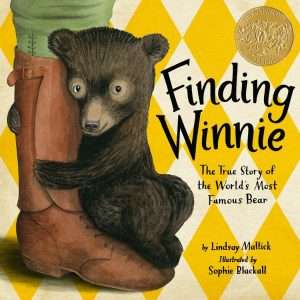
Companion to Winnie’s Great War
The streamlined text and full-color illustrations of this Caldecott Medal-winning picture book tell the full scope of the endearing story of Harry Colebourn and the bear who would become Winnie the Pooh.
A Picture Book Companion is an add-on that can expand the reach of your school-wide reading program when the chapter book might contain themes that are too complex for younger readers, especially your preschoolers. Now everyone can be included! This book even comes with its own set of resources similar to those for the chapter book. You can request to include the Picture Book Companion on the Request A Quote page when requesting a quote on the chapter book above. Picture Book Companions often have an up-charge that will be communicated to you on your quote.