


Read to Them exists to help families discover – or re-discover – the joys and pleasures of reading aloud together. But recent surveys from children’s book publishers reveal that, sadly, increasing numbers of parents or caregivers don’t recognize reading aloud with a child as a fun activity. We know that when children are read to at home, they do better in school and continue to enjoy reading for pleasure as they get older. So what can be done?
Stop thinking of shared reading experiences as a chore, or an obligation. These should be joyful opportunities to sit together and be silly, use your imaginations, or spark wonder. The story is the bridge that takes you both on a new adventure.

You can have fun and learn something.
When you introduce a story to a child (and re-read it over and over), it’s an opportunity to talk about some pretty big things. Stories teach children how to care about other people or animals. Children can get into a character’s head and start to see the world through their eyes. Is there an event coming up that your child is nervous about? Reading a story together about a similar situation can give your child a voice and help them feel seen and heard as they express their reactions. Having a conversation while reading is a safe way to address topics that are sticky or sensitive. These will be bonding moments as you laugh, cry, and talk through the story together.
And, yes, children can learn some reading skills. But this can be done without the child realizing it, just by asking certain types of questions, or highlighting some specific things in the book as you go. When you casually ask your child to notice the sound a letter makes, or point out a detail in a picture, you are equipping them with important foundational skills. This process may not come naturally, but just like running drills in soccer, with a little practice these kinds of conversations will start to feel more authentic. Use the tips below as a playbook for how to get started.
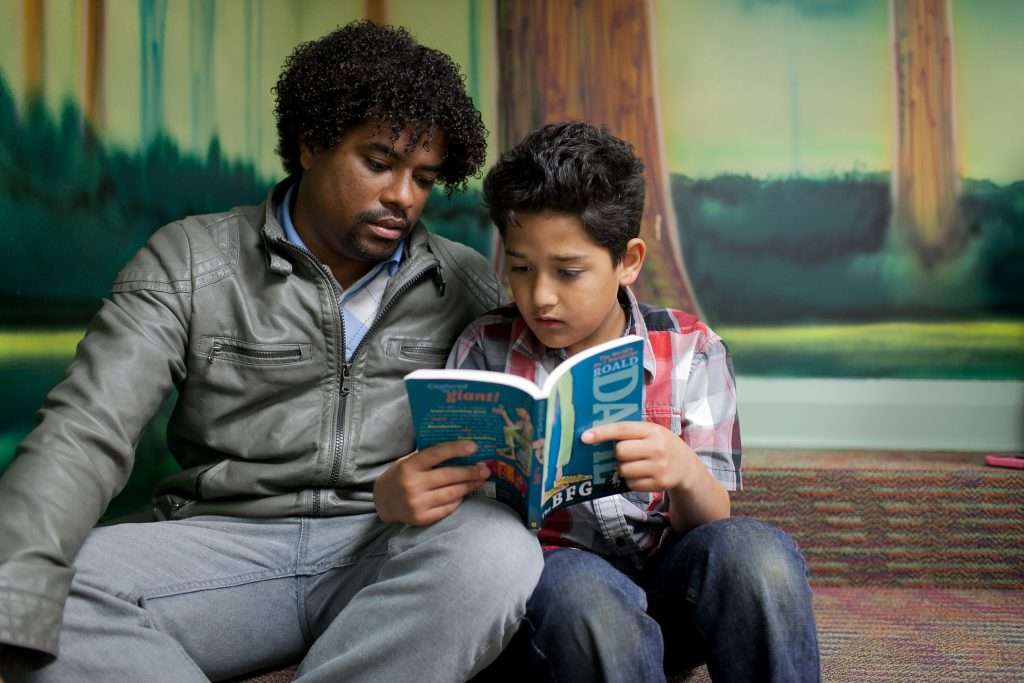
Get started, then get better.
Consider the cover and title. Does it make you wonder what the story will be about?
Skim the pages. Is there too much text? Your child might get restless. Not enough text? This may require more engagement on your part to get them to stay with the story.
Look at the illustrations. Pictures tell a story without words. Is there a lot of detail? Are there secrets hidden in the pictures? What kinds of colors were used? What kind of mood do they create? Point to things that may be unfamiliar. What are the characters eating? Where do they live?
Look at the language. An author’s word choices make great conversation starters.
Do any words repeat? They may be important. Any new words? Ask what they think the word means.
Read with expression. Use different or funny voices for the characters. Not only is this wildly entertaining, you’re showing how reading can feel like a conversation. It should flow, not be sputtered out one word at a time.

Pause and point. Stop at least once every few pages to point to something—a picture, a word in a bold font, a character’s expression. Pose a question: What is that about? See what your child thinks.
Notice the mechanics. Point out that sentences start with capital letters. Take a breath when you come to a comma, and explain why you did so. Sweep your finger under the words as you read, so children see how words go together to make phrases and sentences.
Involve them. Ask your child to read the words with you. If there is repetition or a rhyme, see if your child can guess the next word. If the story is a well-known old favorite, change a key word as you read and see if they notice. Instead of saying, “Goodnight, moon,” say, “Goodnight, alligator.” Give your child a chance to laugh at your mistakes so they know that learning to read may not be easy, but it is fun.
Simply reading aloud is the least we can do. The more we invest emotionally in the telling of the story, by reacting, responding, and questioning, the stronger the connection we make with our children. While research supports reading aloud as foundational to literacy and reading skills, the real gift of reading together is the shared conversations that occur between reader and listener. That is why stories matter. So get in the story game and play!
–

Hillary Wolfe’s writing career began over 30 years ago, when she worked in journalism and then retail advertising and marketing. When she had her children, she switched careers to be a literacy teacher and intervention specialist for students reading below grade level. With her background in writing, Hillary created an experiential writing curriculum that helped over 70% of her students to pass state exams. As her education career evolved to become an instructional coach, intervention coordinator, and finally Director of Curriculum and Instruction, Hillary continued to write for the San Gabriel Valley Newspaper Group as an education correspondent, and eventually ended up back in educational publishing for four years as an editor, curriculum writer, and academic officer. Over the past 20 years, she has served as a district Director of Curriculum and Instruction, Coordinator of Academic Interventions for a county office of education, a K-12 instructional coach, and an elementary literacy specialist. Hillary has written curriculum and professional books on writing strategies, literacy, and phonics instruction, and serves as the contributing editor to the publication Teaching Young Children, from the National Association of Educators of Young Children (NAEYC). She has made presentations on literacy for national and regional organizations, including California Association of Bilingual Educators (CABE), National Council of Teachers of English (NCTE), and International Literacy Association (ILA). Currently, Hillary is consulting for school districts and non-profits.
Find more ideas and storybook prompts at https://www.speakingaboutstories-storytalk.com.


