


Each April, National Poetry Month gives folks the opportunity to celebrate the importance of poetry and the poets whose works actively enrich our lives. Like any creative genre, poetry includes a plethora of themes and terminology to introduce to students. Poetry also presents a wondrous opportunity: the chance to build a bridge between reluctant readers and a love of books.
How can that bridge be poetry?
If you peer back through the door of childhood, it’s likely you memorized a nursery rhyme. Twinkle Twinkle Little Star? The Itzy Bitzy Spider? (Just remembering these titles, you probably have more than one of them stuck in your head.) They’re short, and their simple rhyme scheme makes them easy to recite and recall even years later.
For many of us, nursery rhymes naturally gave way to the witty, nonsensical tales of Dr. Seuss. From Green Eggs and Ham to The Cat in the Hat, to One Fish, Two Fish, Red Fish, Blue Fish and even Oh, the Places You’ll Go!, each is widely accessible in and out of the classroom. Children continue to love these books for their blend of sensibility and silliness, and may not even realize that Seuss’s playful rhyming and repetition helps develop speech and language skills. Seuss’s works also allow children to let loose with their vocabulary acquisition through creating new words like “yuzz-a-ma-tuzz” and “zizzer-zazzer-zuzz” in a delightful sort of nonsense that’s sure to twist the tongue.
The first real foray into poetry that kids are likely to have is with Shel Silverstein, known for The Giving Tree, Where the Sidewalk Ends, and Falling Up. Like Dr. Seuss, Silverstein’s poems welcome kids into a world of quirky characters and outlandish tales. The prose is simple and straightforward, with ample joy and heart, too. There’s also a sense of respect woven through Silverstein’s work, an understanding that children need silliness and to have their unique view of the world honored. Take his poem, “Thumbs” for example:
Oh the thumb-sucker’s thumb
May look wrinkled and wet
And withered, and white as snow,
But the taste of a thumb
Is the sweetest taste yet
(As only we thumb-suckers know).
There’s undeniable childlike humor, yes, but it doesn’t insult a reader’s intelligence in the slightest. What all of these examples do best, though, are pique interest. Bigger than that, these forms are short, making them easily digestible to even the most bristling reader.
You can throw the most compelling of chapter books at a reluctant reader, but the amount of words on the page is still going to spook some of them. But kids who may shy away from a seemingly dense novel may be able to gravitate towards the ample white space around poetry stanzas.
Jason Reynolds – whose novels Ghost and Look Both Ways are available in Read to Them’s catalog– recognized this in a 2017 interview with PBS.
“For some kids,” Reynolds says. “Those words – the amount of words – is equivalent to a snarling dog. So, why not start with the less threatening, palm-sized pup in the [pet store] window? In this case, poetry.”
But the power of poetry is that in spite of this white space, thanks to deft, careful word choice, a single poem can hold the punch of a full-length story.
Books written in verse, for instance, still contain vital literary elements like characters, plot, structure while delving further into things like imagery, symbolism, and metaphors. Each serves as foundational bricks to a child’s developing reading comprehension and literacy skills.
“With the incredible selection of poetry and novels and verse from past to present,” Reynolds claims, “this is an opportune time to use them to chip away at bibliophobia… And once young people experience turning those pages, once the rush of comprehension and completion laps at their psyches for the first time, perhaps they will know they need not fear a thing created to love them, and for them to love.”
Read to Them has a number of novels in-verse in our library of available titles. We invite you to use them as your building blocks for exploring poetry with readers of all ages. Check out the list below:

Booked by Kwame Alexander
Nick is just like any other young teen: he loves soccer, he’s got a crush, and he’s trying to figure out what his future holds. However, when the dependable stability of Nick’s world starts to flounder, he finds himself struggling to stay afloat. Alexander’s poems briskly propel readers through the highs and lows of Nick’s life as he finds solace and solutions, even (unexpectedly) from the books recommended by a teacher who visits him in the hospital! Also available as a graphic novel.

The Crossover by Kwame Alexander
This Newbery Award-winning novel-in-verse brings readers to the basketball court, and into the lives of twin brothers, Josh and Jordan. When the bond between the brothers begins to unravel after Jordan meets a new girl in school, readers will find that the playbooks of basketball and life overlap more than they thought possible. Alexander’s poetry truly dazzles both on and off the court. Also available as a graphic novel.

Love That Dog by Sharon Creech
Jack doesn’t think he can write poetry – because that’s what girls do, not boys. This initial objection, however, is written in the form of a poem, as is every entry that follows. But as Jack’s poetry unit goes on, he finds himself inspired by the work of Walter Dean Myers and decides to write a poem of his own about his dog. Sharon Creech’s short, stunning stanzas beg readers to slow down and appreciate the beauties of poetry beyond the month of April.
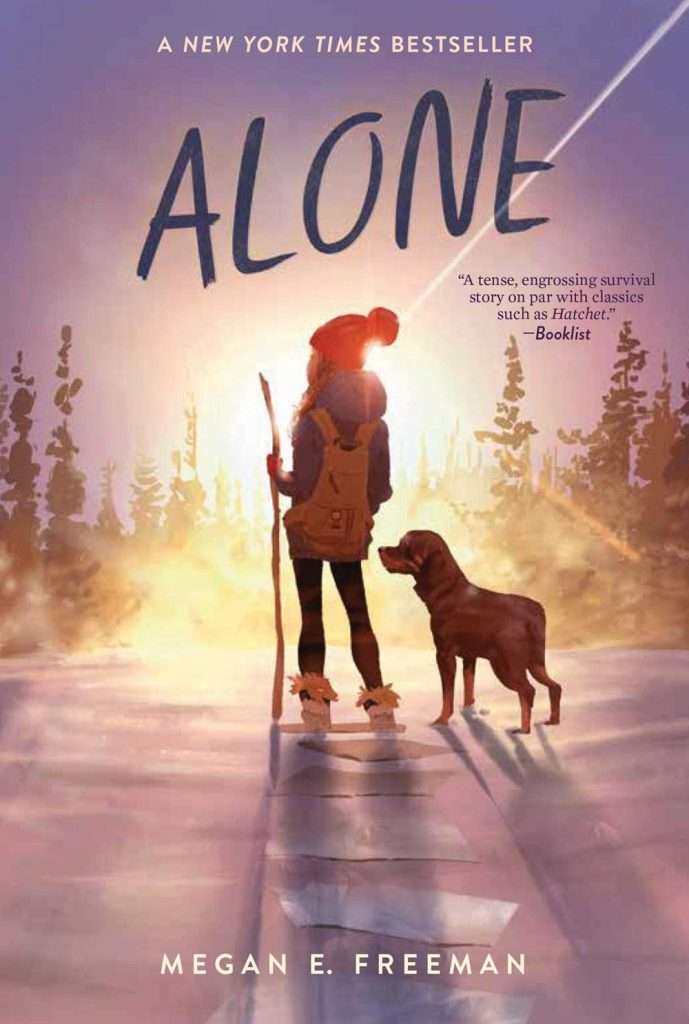
Alone by Megan E. Freeman
12-year-old Maddie Harrison awakes to a world where she’s been unintentionally left behind in a mysterious mass-evacuation from her Colorado town. She has no one to rely on—no power, no internet, no phone. Over the course of three years, she faces natural disasters, looters, and wild animals alongside a faithful Rottweiler named George. Maddie gathers resources, adapts to harsh conditions, and makes use of the town library for both practical knowledge and human connection via fiction and poetry.
Megan E. Freeman gives Maddie her voice by writing Alone in accessible free verse, creating a beautiful window into the inner workings of Maddie’s heart and mind. As Maddie navigates this new world, she battles the biggest challenge of all: loneliness. And she is able to triumphantly answer Mary Oliver’s famous poetic challenge: “Tell me, what is it you plan to do/with your one wild and precious life?”
–
Which poets will you be exploring this April? Let us know in the comments. Happy reading!


